Showing posts with label Dick Jones. Show all posts

Friday, November 16, 2012

Re-view


I interviewed both authors mentioned below when their debut poetry collections were first published earlier this year. I wrote this review around the same time, but despite my luck with getting my own individual pieces published I have had less luck placing reviews, so I'm posting this double act here for your appreciation. 


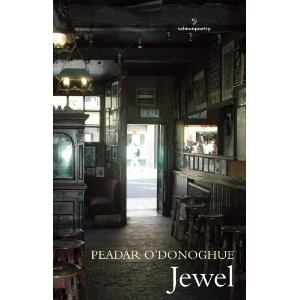
Ancient Lights (Phoenicia Publishing, 2012), Dick Jones, and Peadar O’ Donoghue’s Jewel (Salmon Poetry, 2012)


Dick Jones’ debut is titled Ancient Lights but it is the sense of sound that transfixes us in the first poem of the collection ‘Stille Nacht’. ‘On the night/ that I was born/ the bells rang out’ chimes the first stanza, comparing worship to carolling ‘In Auschwitz-Birkenau’ where ‘the story goes,/ the death’s-head guards/ sang, “Stille nacht,/ heilige nacht”’, and it is sound that transports us through the title poem and beyond.
‘Ancient Lights’ begins self-referentially, knowingly: ‘Banded light, I should remember first’ before exploding into synaesthesia. Each stanza culminates with song so that ‘The conductor haunted/ the stairs in black. We crooned’ fills us with the notion of song being history’s ghost; music therefore, Jones urges us to listen, is time’s time-traveller, a way in to the historical events through what was the primary escapism of those times. We listeners travel chronologically as linear voyeurs ‘on a dim swell of voices’ to ‘a house’ as if of creation, but here Jones reveals his conceit, ‘that’s there already,’ and is ‘free of pain/ and ghosts,’ ending inarguably with ‘fruit/ that falls and germinates/ at random when/ and where it will’, the last line tapering to a single apple drop; the sound of a full stop.
‘And time and place/ conspired:’ in ‘Mr Moore’s Wall-Clock’ evoking for this reader the school rhymes of Yorkshire and of Henry Clay Work’s ‘My Grandfather’s Clock’ and Charles Kingsley’s ‘The Old, Old Song’ (though one must wonder, given the poet’s musical background, if it wasn’t Donovan’s ‘When All the World is Young’ playing through his mind when he wrote it) with such lines as ‘And the world was one green hill, the sky a net’, and ‘Time/ was a circle dance, two hands in rhyme’. The loved face in Jones’ poetry is recognition, of memory, of walls blown down, and of new beginnings built from the ruins. Each stanza pushes forward the narrative like clock workings ‘into shadow, from my midday to Mr Moore’s midnight.’
So seamlessly Jones transports us with his watchmaker’s eye from the intricate brass gears to a ‘First Eclipse’, it is easy to run full pelt through this collection with no more impediment than a child’s desire to empty out the toy box, only his language calls us to pause and marvel. The overarching themes of Ancient Lights are not new but they are brought to the reader with fresh observations and a deft touch leaving one in no doubt Dick Jones is a new talent, one only wonders why it took so long to bring him to print.
Born in war – a beginning from ruins – it is fitting Jones concludes on the moon. ‘I am elected watchman. It’s my lot’ Jones starts then turns the words with a thread of irony easy to miss but difficult not to savour: ‘[…] while man takes giant steps below’. Jones’ collection crescendos ‘like a choir triumphant’ with its song lingering long after the event has ended.
‘The Old, Old Song’ sounds again in the epigraph of Peadar O’ Donoghue’s debut collection. ‘I was never a diamond,’ he explicates, ‘not even a rough one, I can’t polish pearls of wisdom,/ but this is my jewel.’ And Jewel, the collection’s title, is much the finest metaphor one could choose to describe O’ Donoghue’s poems; each one gives the sense of its having been hoarded away for years, polished carefully before being allowed to shine. But there’s the irony for the subject matter of these poems is not what one would wish to show off ordinarily. In the title poem a drunk’s thoughts are brandished defiantly as a whore’s knickers as he personifies the river Liffey: ‘she calls to me in clamshells of desire.’ In this way the poem builds, throwing together imagery as at odds as pissing and consumption, seemingly with all the grace of a chip shop server, to justify the speaker’s ‘relief and satisfaction in equal measure.’ Far from being bawdy the poem is a tour de force in bathos in spite of its vaudeville guise.
Though seemingly pained to acknowledge it, O’ Donoghue has literary authority. In ‘Pictures and Postcards’ we glimpse: ‘Mountains to mist, Beckett to boxer to blonde’, the allusion dissolving like a cloud to the concrete of the fighter and further to the artifice of ‘blonde’. There is reserve here that comes to play as control, there is skill but it is humble; the poems in Jewel down-play themselves, in doing so they demonstrate un-showy brilliance. O’ Donoghue applies comic book humour to take cliché after cliché and crush them Superman-like to reveal the diamond inside. ‘“Stay a while” they seem to say. “Drink your coffee,/ compile this list for lesser days”’ which is surely what O’ Donoghue has been doing with this collection.
Jewel speaks of an Everyman man who has lived a place, caught in its traditions until they have become him. There’s a symbiosis here lending to a Sean O’ Casey poignancy and politics. In ‘This is a Controlled Poem’ O’ Donoghue lets slip his buffoonish masque to cane A S J Tessimond-like ‘the voice of reason’. ‘This poem’ is a rebellion such as only those who have been silenced know. ‘This poem is […]/ a neatly pressed shirt for the office on Monday.’ Duty here mirrors religious observance and ritual but in ‘The Birth of a Nation’ any spiritual intervention is dismissed. ‘It wasn’t a miracle,/ most things are born out of poverty,’ like Christ. We are reminded of this in ‘This Christmas We’. ‘Stretch the fabric of life,’ it urges, boldly, then tears its bravado to scraps, ‘reduce,/ re-use, recycle’ chanted like a drinking song.
O’ Donoghue has kept his poems in his shirt pocket it seems for half a lifetime, gems cut clean from the heart; the words of a shining talent don’t need the allusion to let you know they sparkle, they simply need to be read.

Monday, June 18, 2012

Light of the Word


I first came across Dick Jones’ poetry when I started blogging, back in 2009. I had tentatively posted a poem, the title of which provides the header for this blog. Dick passed through, left a criticism and breezed out much the way people who are better than you do. But there was nothing aloof about Dick, which isn’t to say he doesn’t have the right to be. Indeed, Dick’s poetry, it was clear to me from the off, was never going to settle for blog land, I only thought it a travesty it did for so long. So it gives me immense pleasure to introduce Dick to talk about his debut collection Ancient Lights (Phoenicia Publishing,2012).

Dick, you’ve been here as a much appreciated commenter, your criticism of the poem I mentioned in the introduction really nailed that piece for me (thank you), and I’ve had the pleasure of reading some of your poetry on your Patteran Pages, it’s wonderful to have you here as a guest – finally. Could you tell me a little bit about the genesis of Ancient Lights and why it’s taken so long to get a collection out when clearly you were born spitting similes?

I’m delighted to be here, Rae! Thank you for the invitation. As to the compiling of ‘Ancient Lights’ and the length of time it’s taken me to produce a collection, I think it’s been primarily a function of confidence – the old ‘tread softly because you tread on my dreams’ inhibition. Although I’ve been submitting poems to journals for many years, I’ve only once before tried out for the publication of a book. In fact, had it not been for the energies of the entirely wonderful Beth Adams of Phoenicia Publishing, ‘Ancient Lights’ may well have never come to fruition. I’m enormously grateful to her for her enthusiasm, her encouragement, her efficiency and her patience. 

The first poem in the collection places the reader in the final throes of WW2, your birth. The action’s very at odds with the title ‘Stille Nacht’ in the context of the war but perfectly at ease with the imagery evoked by the English translation of the carol the title is taken from. You do contrasting parallelisms well; it struck me how exquisitely difficult it would be to mimic this technique. What was the process for this poem, how did it come to you?

Second things first. The whole poem tumbled out of the first stanza, which I scribbled into my notebook during a casual chat about Christmas at the poetry group I was attending at the time. We were all seated around our group of tables with Christmas a week or two away and the little conceit about the bells ringing at my birth popped into my head. It turned like a key and for the rest of the first part of the evening’s activities I carried on writing. By the time we got to the last hour of the meeting and the read-around I’d got most of it finished.

So it came out of one of those white-heat momentum processes that I find sometimes drive a piece of writing. When such cataracts occur there is a powerful element of automatic composition about it all. No glazed trances or zombie focus on the task in hand! But there is a sense throughout the writing of receiving something and acting more as an interpreter than one simply putting it all together from a set of components. In fact, this downhill impetus is much more apparent in the crafting of the longer pieces than the shorter. Both ‘Stille Nacht’ and ‘Binners’ (once I got past the first section) evolved more rapidly towards the closest one ever gets to a final draft than many a miniature piece, some of which have been years in the cooking. 

The collection begins with the poet’s ‘I’, giving the works an experienced authenticity, there’s omniscience to your observations. Each poem presents ways of describing familiar and unfamiliar things in a manner that renders them true, universally, yet innovatively (every poet’s wish) - and you have a child’s eye for detail, for what the grown-ups miss - but there’s an authority to your words, wisdom that seems almost to take the poem’s speaker by surprise. Possibly, in context of ‘Stille Nacht’, this is because of the inconceivable circumstance of the mature speaker retelling the memories told to him about his birth as if his own – a peculiar configuration of chronologies – but could you talk a little bit about how memory, yours, others’ or imagined, plays in your poetry? 

It’s peculiarly difficult to account for the operation of memory in my writing. I’m simply so close to the cutting edge of the functional process of collating and organising and then rendering it all that there’s a degree of can’t-see-the-wood-for-the-trees purblindness about it all. However, I am aware that my apparent memories of childhood are an extraordinarily rich compound of actual recall and constantly reiterated family lore. It’s as if the accounts related by my parents, my grandparents and our closest family friends have in some way elided with my own startlingly clear recollections (and my actual childhood recollections go back to the age of about 18 months) to create a kind of fertile humus from which narrative shoots continue to spring, even this far in time from their provenance. This mulching procedure works for all of us, of course, and the intensity of nostalgia evoked by some sound or fragrance is proof of its potency. But I remain baffled and intrigued as to why with me its momentum has been undiminished through the years. Maybe my child within is unusually wakeful and garrulous. One for the head doctors, I guess, but I’m not letting them close! 

Ancient Lights – it’s the perfect title for this collection. Side amble: I’ve always been awed by the seemingly never ending variety of descriptions you give, observations you make about light – it is a strong feature of your work, (obviously in light of the title, pun intended). What surprised me was the sound. In hindsight, it’s hardly surprising – you are a musician – but it was the combined effect of hearing the poems alongside one another, the way each seems to kick off from the previous one so fluidly – it really reads like an orchestral piece. Was this a conscious effort? Did you have to alter the poems after you’d written them to make them link and flow?

To a degree there was a sort of organic self-selection to the order of the poems within the book. I had no great difficulty in putting them all end-to-end. In fact, I did most of it at my partner’s parents' house standing by a laptop on the grand piano while the kids ran riot on the floor! I guess the constant edge of distraction enabled me to push and pull the poems around more intuitively. Too much focussed concentration might have made me too conscious of the demands of the task in hand. 

As to sonic properties in the ordering of the poems, I’m not conscious in retrospect of having sounded them against each other like duelling tuning forks! But at the point of writing I’m acutely sensitive to the way in which the words chime and I repeat sections over and again to ensure that there’s some melodic and/or rhythmic symmetry at work. For better or worse, I always aim for a musicality within each poem and I’m very conscious of the common ground between poetry and music. As an adolescent I was fascinated by the possibilities of poetry and jazz. In fact, all these years on ‘Red Bird’, Christopher Logue’s translations from Neruda spoken to a backing by a fine band led by drummer Tony Kinsey remains a favourite. (I waited for three years on eBay before finally picking up a replacement copy of the original EP!) And beyond the ongoing excesses of gangster rap, there’s some terrific hip-hop around that folds poetry and music into each other to great effect.  So I guess I must have operated as a sort of subconscious conductor when marshalling a whole flock of poems into a book! 

For me, the music really connected with the thoughts your poems inspired about memory; events re-remembered; events that stay with us; that push forward to future generations. Sound and light (senses) are what we remember and light will remain long after we have passed. I’m thinking of Larkin, ‘What will remain of us is love.’ What would you like to be remembered of you, Dick? 

I’m not sure how to answer that question. But for me that concluding line from ‘An Arundel Tomb’ is probably the finest clincher of any poem. Those whom I have loved and who have died are still loved. I have no religious belief at all, having felt at no time through my life so far any need for a god or God. I have a profound faith in the primal and redeeming properties of love between human beings and see no place for divinity above and beyond its transformative power. For me human love, eros and agape, is the light of the world. So I suppose would hope for love to transcend my passing in the hearts of those dear to me now. 


Initially wooed by the First World War poets and then seduced by the Beats, Dick Jones has been exploring the vast territories in between since the age of 15. 

Dick’s work has been published in a number of magazines, print and online, including Orbis, The Interpreter’s House, Poetry Ireland Review, Qarrtsiluni, Westwords, Mipoesias, Three Candles, Other Poetry, Rattlesnake and Ouroboros Review, and in several print anthologies, including Sing Freedom! (Amnesty International), Brilliant Coroners (Phoenicia Publishing), and Words of Power (qarrtsiluni/Phoenicia). His chapbook, Wavelengths, was a finalist in the 2009 qarrtsiluni chapbook contest, and he was nominated for the Pushcart Prize in 2010 for his poem, “Sea of Stars.”

In addition to thirty-five years of teaching drama in progressive schools, Dick Jones has been an avid musician all his life, playing bass guitar in rock, blues, and folk bands. He lives outside London with his wife and children, and blogs at Dick Jones’ Patteran Pages.

Ancient Lights is available to buy through Amazon Us and UK.


Saturday, February 26, 2011

It's not not awards


Thanks this week to the two lovely ladies who blog, respectively, at:
 this writer's life, and
 Ramblings From Yet Another Stranger On The Bus.

I usually deflect awards as the list of conditions for receipt often read like the instructions for flat-pack furniture. And the awards don't colour coordinate with my blog. Oh, and "passing them on" conjures imagery of contagious disease. But, aside from all of that, I appreciate people letting me know they like my blog - that means a lot to me - and it's a nice opportunity for me to note one or two blogs that deserve a mention.

Also, back in October, I said I would take part in a quiz from Patteran's Pages - I hadn't forgotten, Dick, but I hope this will do instead, at least for now.

Both awards ask me to list seven things about myself:

1. I had my first newspaper article published when I was fifteen.

2. I sometimes wake myself up laughing in my sleep and I once had a giggling fit for forty minutes, non-stop.

3. I don't believe you have to find a husband to lose your father's name.

4. My great great grandparents on my maternal grandpa's side were Irish and fled an Gorta Mór.

5. I was Mary in my primary school nativity and the angel Gabriel was my cousin, although I didn't find out until after I left school. My teacher told her she would have made a better Mary. I was deeply hurt (I'd auditioned and everything, and still remember the song!).

6. I was the first girl to wear trousers at my high school (and got summoned to the deputy Head's office for my audacity).

7. I was once dragged by my ear to explain what I thought was funny about The Lord's Prayer - it was this:


For The Love Of God, What's That Up Your Sleeve?


Bless me, mam, for I have sneezed, a snail slick
of snot shot out, top speed, hauled up my arm
and dried shiny hard like a graphite thick
drawing, rubbed, over worked by childish palm

to glossy grey like slates in the rain. And
I tried to explain when Betty dragged me
by the ear but she couldn't understand,
I'd got my head hung so they couldn't see

the candles dripping from my nose, sticking
to my hair, and so she hauled me up on
stage: full view. They all thought I was laughing
as my sniffs increased in speed and not one

explanation could I give standing there
for “what's so funny about the Lord's Prayer?”

And to the nominations; considering these awards are doing the rounds, and the whole six degrees of separation thing, I'll just note a couple of blogs I enjoy reading for kinship as well as content:

Sara Crowley's A Salted - for real and raw writing with no mincing of words.

Lori Tiron-Pandit's Daily Writing - for searching questions and creativity.

Helen Caldwell's My Writing Life - for a store-house of writing related info.


We should all wish for sisters like them.


And thanks again to Leslie and Teresa for nominating me - you are both the human equivalents of home, for different reasons; I want you to know I'd nominate you right back!