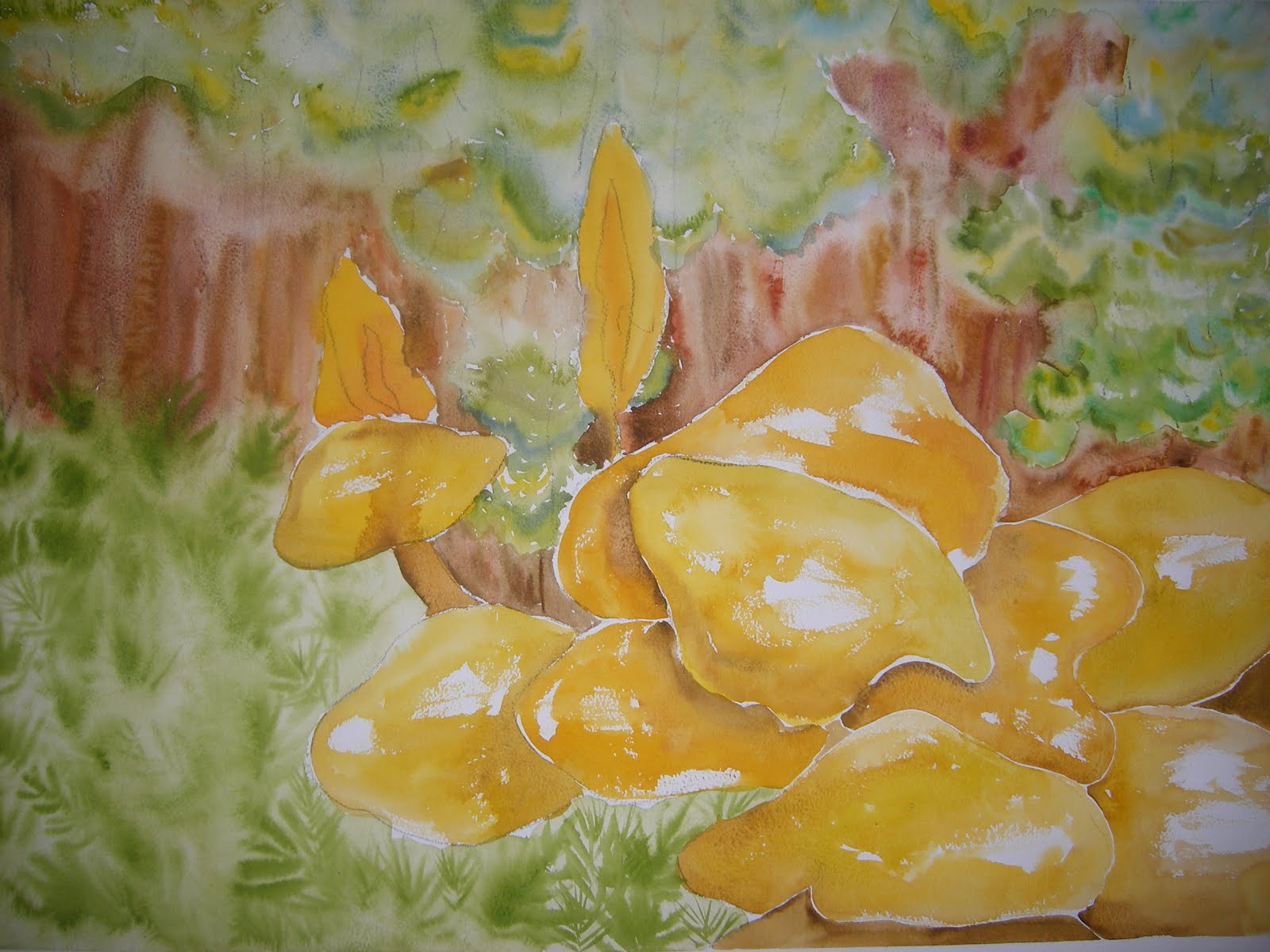
A2 watercolour.
This is my garden. It's been raining and so the only things flourishing right now are fungi but I'm hoping my guest today won't mind.
Hullo and welcome, Grace Wells, to Snowlikethought.
I thought, if it's agreeable to you, Grace, we could talk about your début poetry collection
When God Has Been Called Away To Greater Things whilst perusing the garden here, though I must warn you, it's not at all like most gardens, not finished at all.
Well Rachel, first let me say how lovely it is to be here.
When God Has Been Called Away To Greater Things takes into hand some very difficult subject matter and I'm thinking particularly of the accounts of domestic violence in the book here and of abusive relationships. You said in your interview with Nuala Ni Chonchuir that your “book is like a blueprint, a map for a way out” and I wanted to refer this back to the text, poems such as “Clearing”, which has the margins bursting with thickets and briar and all manner of overgrown brambles and weeds and it struck me that the book describes very well how to cut and clear a way through uncultivated terrain but there is also, running parallel to the human taming of nature; garden versus wild, the notion of the poetry's speaker as wild animal having forged paths through the roots and stems beneath the protection of the vines and I wanted to ask if this was a conscious imagery choice and if you see the garden as the thing being tamed or as the tamer?
And related to that last question I wondered about your thoughts on how much is your representation of garden rooted in the notion of garden as a thing to be fought with – against nature – or a thing which protects and is a barrier against nature? How much of the cutting back is a removal of self defence; an exposing of self?
I do love gardens, and this one, where you’ve listened so acutely to my work, and paid it such a great compliment by thinking about it, and then going on to create this lovely space for me, well, this has to be one of the nicest gardens I’ve ever been in.
But as to your very provocative questions, what can I say? My poem, ‘If I owned a dress’ ends with the lines: “Don’t ask me to understand these mysteries/speak of wildness or explain the freedoms of tamed things”. And I really think I can’t talk about these things, except in elliptical ways through poetry. The trouble is I know a lot about them, about wildness and tamedness. Too much. And I don’t want people to take what I say the wrong way. I certainly don’t want anyone to think I’m suggesting women should be tamed, or anything like that. I’ll try and be succinct about this, but really I could go on for hours. That’s the real reason why I say, “don’t ask me to speak about these things”, because I might never stop.
I know a lot about the pain inflicted by human wildness run amok. I know the horror of being tamed and caged. If I use imagery of the wild animal it’s unconscious—most of my work is created through unconscious processes and edited through conscious ones—but the whole male/female dynamic is deeply concerned and enmeshed in a wildness/tamed dichotomy. That’s at the simplest level, even in the healthiest of relationships, but your questions brought to my mind all those women currently being shipped from foreign countries into the West as sex slaves. They’re like wild creatures being caught and caged, their wildness tamed and abused, just as once men brought animals here for zoos. So I think all this territory is very important, very relevant and in need of being written about.
My major healing came from the wildness of a mountain in Ireland. Of course there were other sources of repair, more expensive ones, therapy and osteopathy, dance workshops and a kind of Spiritual quest. But the key one, the primary one, was my relationship with the peace on that mountain, the stillness within its wild, untamed freedom. So I definitely see the mountain, the wild place, as tamer, it brought me in from the cold, brought me back from isolation.
A garden is a whole other thing. When I bought this land, where I live, it was a wilderness, and awful at that. Briars had won, nettles ruled. There wasn’t the space or the place for anything valuable or beautiful to grow. So it had to be tamed. Now, especially now in the early summer days, my garden is a paradise. It took years to make it that way. And I suppose there was a direct parallel, my garden, like myself, was something that had been ruined by wildness. Taming it helped me to heal. The tamed garden restored and constantly restores my faith in living.
But I also own a field, and my field and I have a constant battle between wildness and being tamed. I have to say, where wildness is tamed there is the chance of beauty, and where tamed things are allowed to run wild, there is also the space for beauty, so it’s about exploration and balance, and knowing what’s good for you.
Later there was love, and this love pushed me back into therapy and to a much deeper level of healing. So ultimately love and maleness and a certain kind of tamedness actually gave me new freedoms. But really don’t ask me to talk about these things, because the boundaries between good wildness, bad wildness, good taming, bad taming, are all so fine and so close, that it’s nearly impossible to speak about them. The only thing I would say is I think these issues are pertinent in every romantic relationship. They’re our dance, and ultimately I do think, horrible as the process may be, they lead to wisdom and even Spiritual understanding. I have a line, which says, “through it’s fire I came to all that remains immutable”. So yes, in answer to your question, all that wildness and taming can expose the true, immutable self.
Sadly women have to be careful the whole time. We need to protect our wildness from harm, but we also need to find safe and appropriate ways to channel it. The truth is, those places where it can be freely expressed are very small within our culture, female wildness, just like areas of natural wildness, are endangered landscapes that we have to keep protecting with vigilance.
Now, if we step this way, I have some lovely fruit trees I'd like to show you, I'm thinking of starting up a little orchard here, mind your head on that apple. Strange fruit that, resolutely refuses to fall.
I should like to talk next about MMR, no, not of the immunisation variety but the Metaphysics, Milton and the Romantics. As I read your poems I felt very much that they were part of a greater literary tradition and at first I thought of the Romantics, Wordsworth primarily but then Blake. I know in your interview over at Women Rule Writer you mention Paula Meehan as a great source of inspiration but I'd like to present a quote from Wordsworth's Preface from Lyrical Ballads and then ask you a little about your ethos:
The principal object, then, which I proposed to myself in these poems, was to choose incidents and situations from common life, and to relate or describe them throughout, as far as was possible, in a selection of language really used by men, and at the same time to throw over them a certain colouring of imagination, whereby ordinary things should be presented to the mind in an unusual way.
(Romanticism: An Anthology 2nd Ed. Wu, Duncan. Blackwell. 2004, p357)
When I began this question I was thinking of your poem,
“Adrienne Wants Due Regard for Home-making”:
Stapled across one crate, a cooling tray for baking
boxed things off like the grille of a cage.
Behind it a pestle for pounding herbs and a paddle
for slapping dairy produce into shape.
From the wire hung an implement for carving butter,
yet sharp and strange enough
for procedures on the body, a forgotten cure
for hysteria, the vapours or nerves.
(Copyright © Grace Wells, 2010)
but now I think of your work as perfectly juxtaposing not only the ordinary made unusual as Wordsworth put it, but of the out of the ordinary made homely, such as the home in “The Only Medicine” being not a home but a prison whereby the outside creeps in to offer promise of escape and the abuser's absence is the comfort which clothes the house and the children. Would you say this contrasting, this juxtaposing of homely with un-homely (I'm thinking Freud here, too) is a particular feature of your writing?
Yes, well people have told me that. In some ways I’m very dim about my own work. I’m always surprised when other people perceive things in it that I’ve done unconsciously. One of my great patrons, Jeff McMahon, editor of Contrary magazine has written that my work: “treats the most ordinary of human concerns, like loneliness, with the most extraordinary language, and treats the most immediate of concerns, like violence, with timeless calm.” I do love language. I love Dylan Thomas, all that wonderful playful spirit within words. So I think, yes, let’s give the ordinary greatness, let’s decorate the ordinary the way people once decorated trees that grew beside holy wells. Most of our lives are ordinary, I think we have to learn to love that, and honour it.
And then of course, life is very brutal, so we have to stay real about that too. I’m not one of these people who is convinced it should all be nice, and we should be happy, I’m much more down to earth.
Another feature which impresses me about your work is your use of metaphor and in particular the way you personify abstract concepts, as you do brilliantly in “Threshold”, to make them not only tangible but human and as possible as meeting a friend in the street. This had me thinking of the Metaphysical poets. Would you say you have anything in common with the likes of, say, Marvell (I'm thinking of The Mower Against Gardens)?
Well Rachel, I must confess to a small secret, don’t tell a soul, but I feel that as we are here in your beautiful garden, I can whisper in your ear: I haven’t read as much as I probably should have. Poetry for me began with Annie Cameron and Raymond Carver. They opened the doors of its wonderful world, and have allowed me to go back and forth in time, reading bits here and there, catching up, learning, loving. But I’m not schooled in poetry, I don’t know my Romantics from my Metaphysicals—(well, not properly, not in depth). I can tell you the names of all the wildflowers that grow around here, but there are gaps in my knowledge of literature. So if there are connections with their work and my own, it’s largely co-incidental. As you asked specifically, I looked up, and really enjoyed The Mower Against Gardens, and I was almost shocked to see that it ends: “May to adorn the gardens stand;/But, howsoe'er the figures do excel,/The Gods themselves with us do dwell.” Which is really the same as the end of my poem “My Garden and Those who made it”, where I say, in the winter the garden dies back, “to reveal the Christ-being within.”

Plants courtesy of author. Raindrops nature's own.
And I am brought to a remembrance of my grandmother's birdbath which had the following inscription on the plinth:
“One is nearer to God in a garden than anywhere else on earth”
There is a strong sense of spirituality which comes through some of your poetry which I found very interesting. As someone who could be described by others as a feminist, I am inclined towards a feeling that a traditional acceptance of God equates to a submission to patriarchal values and I am curious (as Eve) to know, is this something you have thought about in depth or explored with purpose in your poetry?
Absolutely. I ran out of church as a young woman. It mortified and mortifies me the way the church has capped women at the knees. And yet, sooner or later I discovered I was a very spiritually-minded person. I began a quest, dabbling with Buddhism and Sufism and all sorts. I’ve read extensively about prehistoric Goddess culture. I love all that stuff. I just adore going into museums and finding all those wonderful ancient figurines, and all the language written into the symbols drawn on them, all those things Marija Gimbutus has written about. I’ve been to gurus and teachers and a whole crazy jamboree. I’ve tried to find a spiritual pillow on which to lay my head. I think as a woman it’s very hard to find an authentic spiritual centre.
For me female spirituality and female sexuality are two of the last uncharted realms on earth. They’re very connected. So, yes, it’s something I wanted to know about and understand, and then as my life became more complicated, I was forced to explore ideas of forgiveness and so forth, and these questions were really put into my hands like solid objects. I’ve gone hands first into the dark, trying to make sense of them.
For a time I ran a group called ‘Unfolding the Sacred in Women’. We just met together in a local arts centre. We talked and wrote about our spiritual upbringings, we danced, sang, chanted, painted, laughed, cried, explored. It was a wonderful experience. At one point I asked the women to go away and design “churches” or sacred spaces. They came back the following week, and almost to a woman said, “Oh, I didn’t want to, for me sacred space is about sitting out in nature by a stream, or in the woods”. I railed against them, “But it rains, it gets cold. Go back, do it, do this for me”. And back they came the following week with the most beautiful designs you can imagine. Female churches. It was a very powerful experience, first seeing how stripped we’d been, that we didn’t even feel we had permission to do this, and then, when women stepped forward into that creative space, it blew the roof off some things.
In “The New Life: part three, Whenever We Had Sheep in the Field, You Quoted Milton” there is a wonderful evocation of past times, of the pastoral idyll, of Paradise Lost and in the poem as a whole I get the sense of a pagan inclination embracing Christian motifs. Do you feel that spirituality, in the absence of an icon, is possible?
Well I like icons of all sorts, usually the more outlandish and foreign ones, some of the Christian ones give me the creeps, but then they can also be incredibly moving, so I do tend to borrow them and put them in my work. I think that even in the pastoral idyll there were icons, may-poles, the face of the Green Man or the Horned God carved somewhere, maybe even the patterns carved into the woodwork above the threshold, had iconic meaning.
Spirituality without any icon is difficult, and has the potential for the Emperor’s new clothes syndrome, in that some people can see it more clearly than others. I suppose I have absolutely no tolerance at all for religious bigotry or fanaticism, but I actually feel quite generous toward all our different religious furniture and knickknacks. In our women’s group, some women spoke really movingly about creating May alters for Mary, or of little rituals their grandparents had done out in the woods. I love these tangible expressions of our admittance that there is something more than just human ego at work on the earth. Imagine if you put a little bit of everything human beings have ever worshipped into the one room, it would make for a fantastic voyage.
I cannot decide where I want this flax or if I should have a tree where the stream was.
This way leads us to a comfy seat where we can sit back and contemplate the camellias – you know it's coming up for winter here in New Zealand. I cannot get my northern hemisphere brain around the seasonal shift – and, just before we leave literary tradition behind, I thought often whilst reading your poems, of Christina Rossetti. Of her struggle with religious faith. I thought of your imagery of nuns and shamed shaven headed women and I was pondering if you saw the hope at the threshold of your collection, because for all its dark content I did get the sense that it is a very optimistic outwardly hopeful book, and if you see the regeneration of the garden each spring as a fin de siècle catalyst on a smaller, more domestic but no less epiphanic sense?
Yes, ultimately there is hope. I believe we will “leave here brighter than we came”. I believe in the worst of our human suffering there is some kind of spiritual growth. That’s important to me, but it’s a lesson I’m always forgetting. And yes, it is very domestic because after all my searching, my gurus and incense and bells, I came home to being human. I’m not looking for God with tracker dogs and searchlights anymore, I see spirituality in my friends, in the pain within our crazy lives, and out here, in the garden. And though yes, Spring does give us that sense of rebirth, but it’s really Autumn, and the dying back that is in a way more generous, more revealing of our own inner spiritual strength.
Watch out now as we walk this way, I don't mean to alarm you but I have seen a wee green snake about of late. It's so hard to get the balance between acceptable nature and cultivated menace right, I find. I'm sure you have lots of handy gardening tips.
Well, I may do, there’s so much to learn with a garden, it’s a bit like poetry, a never-ending world. Still a snake, now that has to be good. Gimbutus describes it as “a seminal symbol, epitome of the worship of life on this earth. It is not the body of the snake that was sacred, but the energy exuded by this spiralling or coiling creature which transcends its boundaries and influences the surrounding world.” I suspect yours is a Paleolithic or Neolithic snake, maybe it belonged to the Minoan snake goddess, or it crawled off a Scandanavian rock etching in the Bronze age, or slid off from Meigle in Scotland, where Pictish stone carvings have snake Goddesses with legs and hair as twisted snakes. Strange that it should have got stuck here in the Garden of Eden. Don’t you think this would be a good moment to set her free?
Do any of the representations of garden in your poems take root in any actual leafy plot, in reality, or are they pure manifestations of a very rampant imagination?
Oh yes, they’re all real. That’s what’s so terrible and beautiful about it, the dynamic between wildness and order is ongoing, unending, calling me away even now.
For those who would like to know more, and I'd seriously urge bloggers everywhere to take a look at Grace's poetry for yourselves, When God Has Been Called Away To Greater things is available to buy where and how?
You can find it on Amazon, and via Dedalus Press’ own website—www.dedaluspress.com
Finally, Grace, I would like to thank you sincerely for this amble through my little patch, which I have thoroughly enjoyed sharing with you, and to offer you a cutting – virtual of course as the Ministry for Agriculture and Farming (MAF) won't permit real exchanges of plant life overseas – and I also extend warm welcome back to you any time.
Thank you so much Rachel, it’s been brilliant spending time with you. We should definitely do it again!