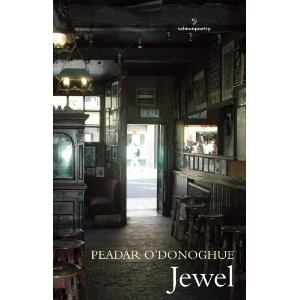
It gives me cheesy grin pleasure to welcome
fabled blogger TFE, otherwise known as poet Peadar O’ Donoghue to Snow Like
Thought to talk about his sparkling debut collection Jewel.
Well it’s great to be here Rae, I’ve never
been to New Zealand before, in fact I’ve never left the front room before, so
it’s a real pleasure, thank you!
Lovely to have you, Peadar, pull up a pew.
Now, it’s easy to churn out the similes for your collection, Jewel, you’ve set
it all up so nicely for us with the title but this seems to be the conceit of
your poems generally. Humour, or rather wit, is omnipresent. There’s a danger
then, would you agree, of the poem’s authority, its substance, being
overlooked? And isn’t that the tragedy of clowns, that everyone laughs and
moves on? So what is it that calls the reader to sit up and listen to your
poems, and they do, beyond the point where the laughter has passed, and how
difficult is it constructing such poems, a poem, say, like ‘With Scant Regard
for Wordsworth’?
I like to make people laugh. I get a kick
out of it and try to do it a bit in real life and a whole lot on Facebook. But
when it comes to writing my poetry seems to spring from a different well
entirely and rarely does humour pop up in one of my poems. There are 52 poems
in the book and only 5 poems are funny (hopefully!) or have elements of humour
in them. So the reader should see a clear line between the funny stuff and the
darker side!
My Wordsworth poem is a parody of his poem ‘Daffodils’ and took
less than 10 minutes to write, but also a lifetime as does every poem.
Wordsworth’s poem is a description of beauty and my poem is beauty destroyed,
all the thoughts I had of corruption and greed that I have witnessed all my
adult life could be encapsulated in the housing madness in Ireland where
outrageous prices were sought for houses (not homes) and financially crippled a
large part of the population. So I didn’t have to create these thoughts, they
were inside me looking for a catalyst to spark their revolution. Some comment
on FB did this (is it obvious yet that I’m hooked on FB?) and all I had to do
(the poem was already there) was change Wordsworth's words (I didn’t know beyond
the first line, I had to look them up) to mine, something I’d wanted to do for
a while! What I mean is that ‘I wandered lonely as a cloud’ was probably the
only line of poetry I knew growing up just like ‘Alas poor Yorick’ or ‘Romeo,
Romeo, wherefore art thou Romeo’ was all the Shakespeare I knew and it just
sounded so poety in that awful poety way that I couldn’t wait to take the piss
out of it. And I see what you mean now in the question but this is the only
poem that blends taking the mick with a heartfelt serious cry of anger. But
maybe I should do more!
And it’s a tricky poem to pull off in terms
of the reputation you’re perceived to be criticising by misreading; it seems to
me there’s a lot at stake with this poem, you cut it to the sapwood. I’ve
thought and thought about this poem, really, I can’t tell you how it has chewed
my brain; I was trying to deconstruct it, then I was thinking, how is
Wordsworth relevant, what is it that connects so powerfully and so deeply
rooted as to make it difficult to express? And I realised, there are three
major things at play, themes of your work as a whole, I think: one is the
language – Irish lyricism and song, and English; the second is politics.
Politics here is also inseparable from the language, I think. I re-read the
collection with these ideas at the fore of my thoughts and I became conscious
of the rhythm shifts from what I would term Peadar-isms – phrases that are
distinctly yours in pattern, regardless of etymology, and what, for want of an
accurate label, I’d call Anglo-isms. Is it possible for an Irish poet writing
in English not to be political regardless of the subject matter, do you think?
Firstly I’m delighted that the poem caused
such a reaction in you, ultimately that is surely what a poet wants, a
reaction? And perhaps we should remember that poetry really is a two way thing,
almost a dialogue, a deeply personal one, and just as the writer brings a
lifetime of experiences to the table, so does the reader.
I think you are right there are 3 major things in my poems. I love words and
language, I love playing with them/it, I love music and song lyrics, I love the
sounds of words. I’m pleased you coin the word Peadarisms, as I like to think
(for good or bad) that I have a unique voice. Anglo-isms too, I spent a large
part of my life in England and that obviously shapes who I am and what I think.
As for politics, I’m quite political, I care about things,
particularly injustice, inequality, cruelty, bullying, violence, love, hate,
hypocrisy. And as I’m a hypocrite myself and do little about any of these
things and am probably capable of most of them, I feel well equipped to write
about them. Is it possible for an Irish poet writing in English not to be
political? Certainly. I see it every day.
I think if Wordsworth could have cracked a
few more jokes and let the metre run he’d have been your equal. You write from
the persona of the common man, and an Irish man, in terms anyone can
understand, yet you manage to turn ordinary, even hackneyed phrases,
Rumplestiltskin-like, into gold. If you had to write a manifesto, what would it
include?
Oh I love that, Willy could have been my
equal! Ha Ha! Thank you my epitaph is written! A manifesto? Wow! I don’t know
but if I could rule the world, first I’d get Rapunzel to let down her hair,
then I’d put honest benevolent dictators with the wisdom of Solomon in charge
of each country in the world and do away with politicians entirely. When I say
‘do away with’ I don’t mean kill them, just rough them up a bit and make them
live on a desert island together.
Finally – easy questions to end on – who
are your influences?
I don’t really have any influences but I
was ‘transformed’ on a visit to Heptonstall so I would have to say Ted Hughes
and Sylvia Plath.
What was your route into poetry?
I didn’t know anything about poetry, I just
wanted to express myself, I wanted to be heard. I wrote in isolation, sent
poems off in isolation and was plucked from obscurity by the wonderful Jessie
Lendennie of Salmon Poetry.
What’s next for Peadar O’ Donoghue?
I have a magazine called The Poetry Bus,
I’m working on the 4th issue (PB4) doing readings from Jewel where I
can and dreaming of a second collection for 2015! (If I live that long!)
Where can we buy Jewel/find you?
There’s a danger one is dazzled by the
sparkle and misses the craft involved in turning a lump of rock into a gem. I
hope we’ve given readers a reason to look beneath the starlight at the grounded
words, where the real treasure is. Thank you, Peadar.
Peadar O’Donoghue has had poems published in Poetry Ireland Review, The SHOp,
Revival, Bare Hands Poetry, Can Can, and The Burning Bush. He has also published
flash fiction in Ink Sweat and Tears. He founded, runs, and edits The Poetry
Bus Magazine, an innovative journal of art, fiction and poetry, accompanied by
a CD of the poets reading their work. An accomplished photographer, Peadar’s
photos have been selected for a solo exhibition at The Signal Art Gallery, Bray
and group exhibitions for Wicklow Arts Office and The Mermaid Arts Centre,
Bray. They have been published in The Stinging Fly journal (and anthology) and
The SHOp, including several front cover. They have also been published in Magma
and The Dubliner.