Wednesday, December 12, 2012

Annexed big thing


Last week Catherine McNamara invited me to take part in The Next Big Thing. Catherine is a novelist and short story writer whose collection 'Pelt and Other Stories' is coming out with Indigo Dreams Publishing in 2013. Please take some time to peruse Cat's sites.

“The Next Big Thing is a great way to network with fellow writers and to find out a bit more about what they're working on. The idea is fairly simple. You, the writer, answer a standard(ish) set of 10 questions on your blog one week then ask up to five other authors (whose work you like and you think might be The Next Big Thing) to answer the same questions the next week.”

What is the title of your next book?
I’m currently working on a novel, but I’m too superstitious to talk about that before it’s completed, so I’m going to tell you about the collected short fiction I have out on submission: ‘Songs from a Room’.

Where did the idea for the book come from?
I had been putting together a different group of stories, pieces that had been listed in competitions such as the 'Sean O’ Faolain International Short Story Prize', or published individually, with a mind to submitting to the Scott Prize. Those were stories that had been written over a number of years and though some were linked, and all evidenced a continuation of the same themes, I felt I could write something much stronger, more like a novel in scope, but with the variety and intensity that only short stories can offer. I wanted to push the form. Reportage, social media, poetry, folk songs, and hymns evidence some other forms I wanted to play with. So I put all my ideas into a notebook, with mail shots and graphics and clippings and newspaper articles and all manner of things that were pushing me to write about them and had been pushing at me for a long time, and the collection took shape.

What actors would you choose to play the part of your characters in a movie rendition?
An international ensemble is needed with lots of interesting ladies and gents of all ages. There are some stunts to take into consideration when casting, but I think Phoebe Tonkins would be ace as Psyche, and I’d love Dominic West to play the 'Man Who Talks to Books', and Jemaine Clement and Bret McKenzie would have to star too. Caroline Gage would play herself. A cameo from Leonard Cohen is definitely in order. Plus a few, as they say in Auckland, ‘unknowens’.

What is the one sentence synopsis of your book?
Listen with your eyes.

Will your book be self-published or published by an agency?
Ideally, ‘Songs from a Room’ will be published by the small press of my choice, renowned for producing beautiful and inspiring books, but I’m a creative thinker and anything’s possible. One idea I had was to hire actors to read the stories and sell the collection as an audio work.

How long did it take you to write the first draft of your manuscript?
Because I planned the whole collection out in advance, the first draft took about four months.
I took a gamble entering untried stories into a major first collection competition. That said, I knew these stories were better than any others I’d written; when push came to shove, I wasn’t prepared to patch-up old work and force links to pad out the few excellent pieces I had, or send sub-standard stories out to represent me. I wanted to create a piece of art. I think I have.

The title story has just been accepted for publication in the New Zealand journal Brief, along with another from the collection, and the second story, ‘The Angel of the Warmth’ made the shortlist of the Bristol Prize, earlier this year, so it looks like the gamble’s paying off in part at least.

What other books would you compare ‘Songs from a Room’ within the genres?
I’ve done my best to defy comparison on the whole. But just prior to writing this collection, I read and was impressed by the work of Te Awhina Arahanga, Nathan Englander, David Down, Eru J. Hart, Paula Morris, Peter Stamm, Phil Kawana, and I am a fan of Annie Proulx, Katherine Mansfield, Angela Carter, Italo Calvino, Ma Jian, and Nadine Gordimer, and if I could inhabit a space somewhere between them, I’d be very happy indeed.

Who or what inspired you to write the book?
Moose. But mostly the idea that everyone has a soundtrack: the break-up song, the clubbing song, the funeral song, etc. Put together Jason Mraz’s ‘I’m Yours’, Cat Stevens’ ‘First Cut’, and McAlmont andButler’s ‘Yes’, and you have the story arc of a first relationship, but what interested me was what other kinds of music would make those life events just as memorable. 

I’ve always been obsessed by structure, so I borrowed the framework for the collection from Leonard Cohen’s brilliant music album of the same name. The songs in this album also inspired a number of the stories, and Mr Cohen was gracious enough to give me permission to incorporate some of his lyrics in those stories. Each story riffs off its sister, building to what I hope will be a collection as memorable as your favourite album.

What else about the book might pique a reader's interest?
People who love concept albums may also like this. Interest alert all criminology undergrads, I believe I have penned the first story depicting yarn bombing.

"Now it is time to pass the baton and introduce a few writer friends (and great bloggers) who will take part in The Next Big Thing on Wednesday 19th December."

Let me introduce:

Saturday, December 8, 2012

Friday, November 16, 2012

Re-view


I interviewed both authors mentioned below when their debut poetry collections were first published earlier this year. I wrote this review around the same time, but despite my luck with getting my own individual pieces published I have had less luck placing reviews, so I'm posting this double act here for your appreciation. 


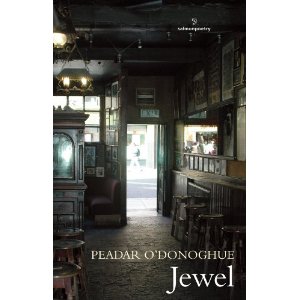
Ancient Lights (Phoenicia Publishing, 2012), Dick Jones, and Peadar O’ Donoghue’s Jewel (Salmon Poetry, 2012)


Dick Jones’ debut is titled Ancient Lights but it is the sense of sound that transfixes us in the first poem of the collection ‘Stille Nacht’. ‘On the night/ that I was born/ the bells rang out’ chimes the first stanza, comparing worship to carolling ‘In Auschwitz-Birkenau’ where ‘the story goes,/ the death’s-head guards/ sang, “Stille nacht,/ heilige nacht”’, and it is sound that transports us through the title poem and beyond.
‘Ancient Lights’ begins self-referentially, knowingly: ‘Banded light, I should remember first’ before exploding into synaesthesia. Each stanza culminates with song so that ‘The conductor haunted/ the stairs in black. We crooned’ fills us with the notion of song being history’s ghost; music therefore, Jones urges us to listen, is time’s time-traveller, a way in to the historical events through what was the primary escapism of those times. We listeners travel chronologically as linear voyeurs ‘on a dim swell of voices’ to ‘a house’ as if of creation, but here Jones reveals his conceit, ‘that’s there already,’ and is ‘free of pain/ and ghosts,’ ending inarguably with ‘fruit/ that falls and germinates/ at random when/ and where it will’, the last line tapering to a single apple drop; the sound of a full stop.
‘And time and place/ conspired:’ in ‘Mr Moore’s Wall-Clock’ evoking for this reader the school rhymes of Yorkshire and of Henry Clay Work’s ‘My Grandfather’s Clock’ and Charles Kingsley’s ‘The Old, Old Song’ (though one must wonder, given the poet’s musical background, if it wasn’t Donovan’s ‘When All the World is Young’ playing through his mind when he wrote it) with such lines as ‘And the world was one green hill, the sky a net’, and ‘Time/ was a circle dance, two hands in rhyme’. The loved face in Jones’ poetry is recognition, of memory, of walls blown down, and of new beginnings built from the ruins. Each stanza pushes forward the narrative like clock workings ‘into shadow, from my midday to Mr Moore’s midnight.’
So seamlessly Jones transports us with his watchmaker’s eye from the intricate brass gears to a ‘First Eclipse’, it is easy to run full pelt through this collection with no more impediment than a child’s desire to empty out the toy box, only his language calls us to pause and marvel. The overarching themes of Ancient Lights are not new but they are brought to the reader with fresh observations and a deft touch leaving one in no doubt Dick Jones is a new talent, one only wonders why it took so long to bring him to print.
Born in war – a beginning from ruins – it is fitting Jones concludes on the moon. ‘I am elected watchman. It’s my lot’ Jones starts then turns the words with a thread of irony easy to miss but difficult not to savour: ‘[…] while man takes giant steps below’. Jones’ collection crescendos ‘like a choir triumphant’ with its song lingering long after the event has ended.
‘The Old, Old Song’ sounds again in the epigraph of Peadar O’ Donoghue’s debut collection. ‘I was never a diamond,’ he explicates, ‘not even a rough one, I can’t polish pearls of wisdom,/ but this is my jewel.’ And Jewel, the collection’s title, is much the finest metaphor one could choose to describe O’ Donoghue’s poems; each one gives the sense of its having been hoarded away for years, polished carefully before being allowed to shine. But there’s the irony for the subject matter of these poems is not what one would wish to show off ordinarily. In the title poem a drunk’s thoughts are brandished defiantly as a whore’s knickers as he personifies the river Liffey: ‘she calls to me in clamshells of desire.’ In this way the poem builds, throwing together imagery as at odds as pissing and consumption, seemingly with all the grace of a chip shop server, to justify the speaker’s ‘relief and satisfaction in equal measure.’ Far from being bawdy the poem is a tour de force in bathos in spite of its vaudeville guise.
Though seemingly pained to acknowledge it, O’ Donoghue has literary authority. In ‘Pictures and Postcards’ we glimpse: ‘Mountains to mist, Beckett to boxer to blonde’, the allusion dissolving like a cloud to the concrete of the fighter and further to the artifice of ‘blonde’. There is reserve here that comes to play as control, there is skill but it is humble; the poems in Jewel down-play themselves, in doing so they demonstrate un-showy brilliance. O’ Donoghue applies comic book humour to take cliché after cliché and crush them Superman-like to reveal the diamond inside. ‘“Stay a while” they seem to say. “Drink your coffee,/ compile this list for lesser days”’ which is surely what O’ Donoghue has been doing with this collection.
Jewel speaks of an Everyman man who has lived a place, caught in its traditions until they have become him. There’s a symbiosis here lending to a Sean O’ Casey poignancy and politics. In ‘This is a Controlled Poem’ O’ Donoghue lets slip his buffoonish masque to cane A S J Tessimond-like ‘the voice of reason’. ‘This poem’ is a rebellion such as only those who have been silenced know. ‘This poem is […]/ a neatly pressed shirt for the office on Monday.’ Duty here mirrors religious observance and ritual but in ‘The Birth of a Nation’ any spiritual intervention is dismissed. ‘It wasn’t a miracle,/ most things are born out of poverty,’ like Christ. We are reminded of this in ‘This Christmas We’. ‘Stretch the fabric of life,’ it urges, boldly, then tears its bravado to scraps, ‘reduce,/ re-use, recycle’ chanted like a drinking song.
O’ Donoghue has kept his poems in his shirt pocket it seems for half a lifetime, gems cut clean from the heart; the words of a shining talent don’t need the allusion to let you know they sparkle, they simply need to be read.

Saturday, October 20, 2012

Draw off


(Picture credit: google images)

I've had an up and down couple of weeks, as noticed in my last couple of posts, but Saturday seems to have offered a condensed version of the whole month's endeavours.

I got a rejection from The New Yorker. Having made it my goal to aim higher, I found I can fall further and still get up again. And it's a good story and it was a good rejection, so plenty still to milk from the experience. Getting a story in The New Yorker just became more appealing than ever.

I went to the Armageddon Expo, for a dose of all things comics and costume. I took my daughter, and we queued for over an hour in front of the funniest trio I have ever heard. They offered running commentary on everyone's costumes and were generally the highlight of the whole afternoon. I said hullo to Adrian Kinnaird, bought Ant Sang's graphic novel, Shaolin Burning, and the very friendly Karl Wills' Princess Seppuku and the Hunt for Robot -X. I got welted by a huge plastic weapon strapped to someone's back - as they turned, it almost took me out! And velcro'd to a large passing pseudo-soldier. And charged by a large lady who appeared to be on the brink of a crowd induced panic but had in all likelihood just caught a glimpse of a dalek and wanted an autograph, almost exterminating me in the process. And my daughter got scammed by the sweet n' salty pop-corn vendor.

I came home to find an email informing me I made the shortlist of The Royal Society of New Zealand Manhire Prize. It was a fun thing to enter because I got to choose a nom de plume - mine was Scott Falcon. I'll send a hand written poem to the person who can work out how I came up with that name. I'm thrilled to have made the shortlist, as the entries are "judged on their literary merits AND the extent to which they engage a non-scientific audience." Which is the sweetest part of all.


Friday, October 5, 2012

Leader board

Last week, I was in a bit of a sludge, having lost my focus; sometimes, writing being the solitary act it is, it's easy to feel a little alone with one's thoughts, easy to create a few negative voices for company where there really are none.

This weekend, my daughter is in Wellington, competing in the National Surf Life Championships. So far, she has won, with her team, silver and bronze medals. It's taken hard work to get there; a couple of years ago, she couldn't even swim. She doesn't complain about all the training she has to do, getting up at 5:30 am every Saturday morning when most kids her age are sleeping in, she just does it.

I'm going to take her lead.

Friday, September 28, 2012

By myself

Ages ago I started to post a graphic sequence about dyscalculia. I didn't finish it, in part, because it isn't finished - it's just more of the same, every day - another reason was because it was bringing to the fore how frustrating it is just knowing its there, cocking me up on a daily basis, and it reminded me how I'm letting it hold me back.

I'd love to do an MA, then a PhD - and the associated things, research, lecturing, papers, conferences, books, but the merest thought of schedules, timetables, funding applications, statistics, getting out of the door on time, and more importantly, getting back to pick the kids up in time, all keeps me within a mile radius of kindy and school, and myself, in a very small place. Usually, I'm home. 

It's not like my time is wasted, however; I write whenever I have the house to myself, edit in any spare minute the kids are home, and read in the evenings, and I've got enough work ticking over to keep me busy editing for the foreseeable. Being busy isn't the issue. And it's not like I haven't done anything like it before; I did a bachelors when my daughter was a toddler. I already know how hard it is to get to places for a given time. 

I miss out on many writing related opportunities because I miss-read submission dates or submission details or I get so stressed anticipating some numerical fuckwittery that I self-destruct. 

Another reason I didn't finish the comic is the same reason I go for weeks without blogging, tweeting, facebooking - time doesn't have those pieces to move about for me. When I miss the window of opportunity one day, I struggle to work out how to fit it in the next where everything already has its place predetermined.

My husband, math whizz that he is, says things like, use a calendar, Windows planner or write yourself spreadsheets to put in all the submission dates. Good one, Einstein. Would if I could. He doesn't get it, probably because there are times, when I'm not stressed, when I'm actually up to primary school competence with maths, and once or twice I've solved simultaneous equations. Once or twice, maybe more but I can't remember more than a few digits. There are people the world over, trying to call me only I've given them the wrong telephone number.

Lastly, I didn't finish the comic because it would be a long victim yawn like this post. And I don't buy into that; it's not who I want to be.


Sunday, September 2, 2012

Reading Kiss

I have a poem, "The Kiss", in Issue 18 of The French Literary Review. Sincere thanks to Editor Barbara Dordi for including it.

If you haven't come across this journal yet, I urge you to subscribe. It's "for writing with a French connection from anywhere in the world", a little gem I found when ambling in Nuala Ní Chonchúir's publication footsteps. Issues 8, 9, 10, 12, 16 and soon 18 can be viewed on the Poetry Library Magazines website.